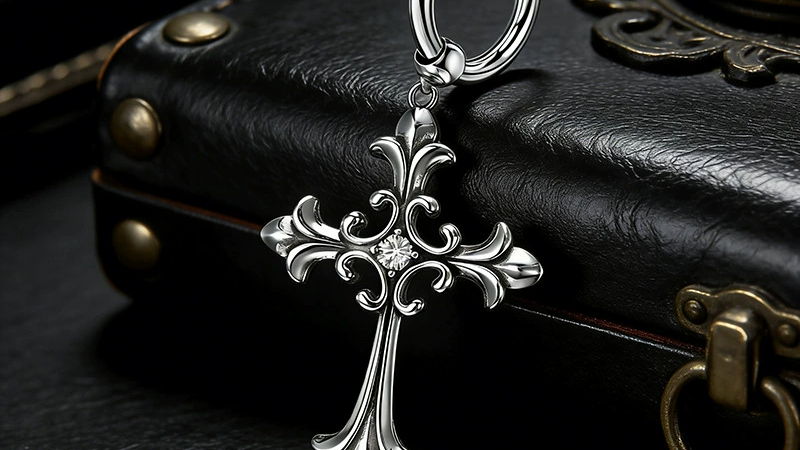
There is a reason the cross has outlived empires. Not as a museum relic, but as a daily companion – worn against the chest, tucked under a collar, or resting openly on a linen shirt. That reason is not fashion. It is faith, memory, and a story two thousand years old.
For anyone who has ever wondered why a Cross pendant necklace feels different from any other piece of jewellery, the answer begins on a hill called Golgotha. And it continues in your living room, your commute, your quiet moments of doubt or gratitude.
The Unbroken Thread: From Calvary to Your Collarbone
The Christian faith is not a philosophy. It is an event. The event of Jesus Christ – born in a feeding trough, executed on a wooden cross, and raised from death on the third day. That cross, once an instrument of shame, became the hinge of history.
When you choose a Cross pendant necklace, you are not selecting an ornament. You are reaching for that same hinge. Early believers traced the cross on their foreheads before meals. Medieval pilgrims carved tiny crosses from olive wood. Today, we refine the same symbol in sterling silver and gold – not to replace the old ways, but to carry them into boardrooms, hospital wards, and kindergarten drop‑offs.
The Bible captures this in a single verse: “May I never boast except in the cross of our Lord Jesus Christ” (Galatians 6:14). That is the inheritance. Every Cross pendant necklace worn with intention repeats that boast – quietly, without a single spoken word.
More Than Metal: What the Cross Actually Means
Symbols only matter if they point to something real. The cross points to three realities that no trend can erase.
First, sacrifice. Jesus did not die a martyr’s death. He died a substitute’s death – for you, for me, for the person who cut you off in traffic. A Cross pendant necklace worn in the morning becomes a quiet reminder: I am loved at a cost I could never pay.
Second, victory. The cross is not a tragedy. It is a throne. Because three days later, the tomb was empty. Christians do not wear crosses to mourn a dead teacher; we wear them to celebrate a living King. That empty cross (the most common style in Protestant jewellery) declares that evil, sin, and death itself have been defeated.
Third, identity. When you put on a Cross pendant necklace, you are echoing the oldest confession of the church: “Jesus is Lord.” Not in a aggressive way. Not as a badge of superiority. Simply as a fact that shapes how you forgive, how you work, how you love your enemies.
This is why a cross pendant never feels hollow. It is loaded with meaning – meaning that has comforted the dying, strengthened the persecuted, and turned ordinary people into saints.
A Heritage You Can Feel: Why Christians Pass Down Crosses
Ask any believer over sixty about their first cross. Chances are, they will name a person – a grandmother, a godparent, a Sunday school teacher. The Cross pendant necklace is one of the few objects that travels seamlessly from a baptismal font to a graduation party to a nursing home.
That generational weight is not accidental. The Bible commands parents to “impress these commandments on your children” (Deuteronomy 6:7). A cross around the neck does what a book cannot: it stays. It touches the skin. It becomes part of daily rhythms.
I have seen a tarnished silver cross pulled from a soldier’s uniform pocket. I have seen a gold pendant passed from a dying mother to her daughter during chemotherapy. These are not sentimental stories. They are the living heritage of the Cross pendant necklace – a heritage you can begin today, whether for yourself or for a child yet to be born.
Where Faith Meets Daily Life: Real Scenarios for Your Cross
You do not need a church building to wear your cross with purpose. Here are six ordinary moments where a Cross pendant necklace becomes a silent ministry.
At work. Before a tense negotiation or a difficult feedback session, your fingers find the pendant under your blouse. It steadies you. Not because metal has power, but because the One it represents promised never to leave you.
During travel. Airports, foreign cities, lonely hotel rooms – the cross on your chest is a portable altar. Many travellers report feeling less anxious when they can touch their pendant. It is a tactile prayer.
In parenting. A toddler tugging at your Cross pendant necklace becomes a teaching moment. “This reminds us that Jesus loves us.” No sermon needed. Just a symbol and a sentence.
Through grief. The hospital waiting room is where the cross speaks loudest. Not with answers, but with presence. The same God who hung on a cross understands suffering from the inside. Your pendant whispers that truth when your voice fails.
At celebrations. Weddings, baptisms, anniversaries – a fine Cross pendant necklace gifted on these days becomes a landmark. Years later, the recipient will remember not just the gift, but the giver and the grace.
In solitude. Morning coffee, evening journaling, a quiet walk. The cross resting against your chest aligns your heart with the ancient rhythm: “Christ has died. Christ is risen. Christ will come again.”
What Makes a Cross Pendant Necklace Worthy of Daily Wear?
Not every cross endures. I have seen cheap alloys turn skin green. I have seen chains snap at the worst moment. A Cross pendant necklace intended for years of use – not occasional display – demands honest craftsmanship.
Here is what to look for, whether you buy from us or anywhere else.
Metal matters. Sterling silver (925) is the minimum standard. It tarnishes but cleans easily. Stainless steel (316L) is virtually indestructible – perfect for active men and women. Gold‑filled offers the look of solid gold at a fraction of the price and far more durability than gold plating.
Chain construction. A beautiful cross on a flimsy chain is a disappointment waiting to happen. Look for rope chains or curb chains with solid links. Avoid hollow links or glued clasps. The best Cross pendant necklace designs use a lobster clasp – secure, easy to handle, and long‑lasting.
Pendant thickness. Thin stamped crosses bend. A quality pendant is cast, not stamped. Run your thumb across the edge. If it feels sharp or paper‑thin, keep looking.
Engraving depth. Many crosses carry Bible references (John 3:16, Philippians 4:13, Joshua 1:9). Those letters should be deep enough to survive years of skin contact and occasional cleaning. Shallow laser etching fades.
Length and fit. A 16‑18 inch chain sits at the collarbone – visible but not shouting. A 20‑22 inch chain drops lower, often over a sweater. The right Cross pendant necklace feels like a second skin, not a constraint.
The Unfading Appeal of Christian Crosses in Modern Style
Some worry that wearing a cross looks outdated or overly religious. The opposite is true. Across fashion capitals – from Milan to Seoul – the Cross pendant necklace has become a staple for believers and non‑believers alike. But for the Christian, it carries an extra dimension: it is beautiful because it is true.
Minimalist designs (thin profiles, clean lines) appeal to younger buyers. Heirloom pieces (thicker silver, engraved verses) attract those who want weight and permanence. Celtic crosses, Jerusalem crosses, Latin crosses – each style tells a different part of the same gospel.
You do not have to shout your faith. You simply have to wear it. And a well‑chosen Cross pendant necklace does exactly that: it speaks without arrogance, invites without pressure, and endures without apology.
A Final Word: Your Cross, Your Story
The Bible ends with a vision of a new creation – and at its centre, no temple. Because the Lord Himself is the temple. Until that day, we have signs. We have symbols. We have the cross.
Whether you are buying your first Cross pendant necklace or adding to a collection, remember this: you are not purchasing jewellery. You are stepping into a story that began before time and will continue after every trend fades.
Wear it with joy. Gift it with prayer. And let the cross on your chest do what it has done for two thousand years – point the world to a Saviour who is still alive.
Thank you for reading. May the peace of Christ go with you – and may the cross you wear be a true reflection of the One who wore it first
For two millenni–learn more